
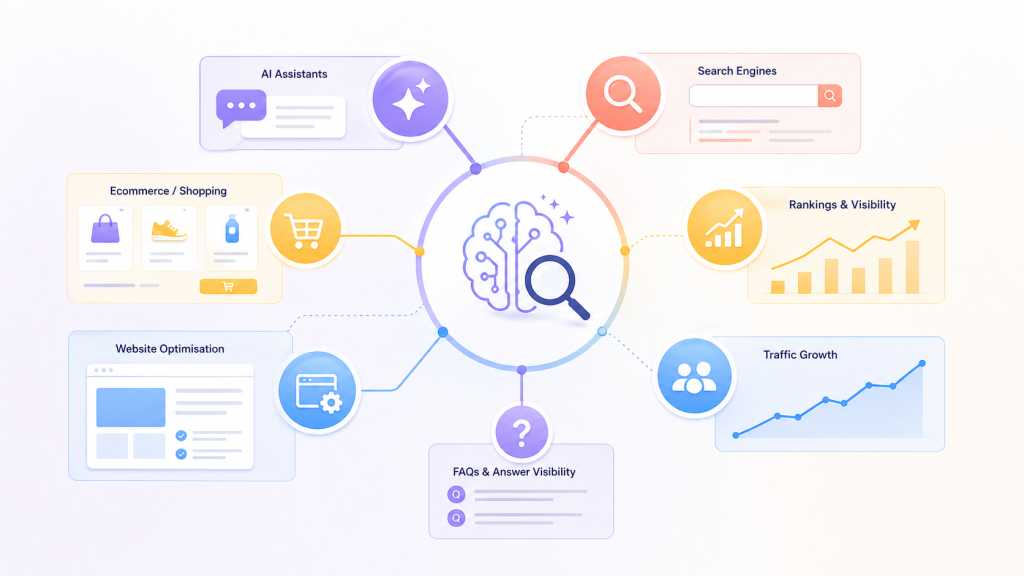
Businesses are finding out how powerful AI SEO is for their business
Your future customers may already be asking Google AI, ChatGPT, Gemini and Perplexity which business to choose — and if your website is not clear, useful and trusted, you may not be included in the answer.
That is the new reality of search.
For many years, search engine optimisation was mostly about helping your website rank higher on Google. That is still important. But the way people search is changing quickly. Instead of only typing short keywords into Google and clicking through a list of websites, people are now asking full questions to AI tools.
They are asking things like:
“What is the best Shopify store for organic bamboo bedding in Australia?”
“Which ecommerce brand sells premium slow-cooked dog food?”
“What should I look for when choosing a buyers agent?”
“Who are the best SEO companies for Shopify stores?”
“What is the best product for sensitive skin?”
The answers they receive may mention specific brands, products, services, reviews, comparisons and recommendations.
That is where AI SEO comes in.
AI SEO is the process of making your website, content, products and brand easier for both traditional search engines and AI search tools to understand, trust and recommend.
It is not about tricking AI. It is not about stuffing your website with keywords. And it is not about publishing hundreds of low-quality AI-written articles.
Good AI SEO is about making your business clearer, more useful and more credible online.
For business owners, this matters because search is no longer just about being found on page one of Google. It is also about being included in the answers people receive when they ask AI tools for help, recommendations and buying advice.
What Does AI SEO Mean?
AI SEO means optimising your website so it can perform better in search engines and AI-powered discovery platforms.
Traditional SEO focuses on areas like:
- Keyword research
- Website structure
- Page titles and descriptions
- Content quality
- Backlinks
- Site speed
- Technical SEO
- Local SEO
- Ecommerce SEO
AI SEO still includes many of those things. The difference is that AI search tools also need to understand context, meaning, trust and usefulness.
For example, a normal SEO strategy might target a keyword like:
“bamboo sheets Australia”
An AI SEO strategy would go deeper and help search engines understand:
- What type of bamboo sheets you sell
- Who they are best suited for
- What makes them different
- Whether customers trust your brand
- Whether your product pages answer buyer questions
- Whether your content explains care, sizing, comfort, materials and delivery
- Whether your website demonstrates real experience and authority
In simple terms, traditional SEO helps search engines find your pages.
AI SEO helps search engines and AI tools understand why your business deserves to be recommended.
Why Is AI SEO Important?
AI SEO is important because customer behaviour is changing.
People do not just search with two or three words anymore. They ask detailed questions. They compare brands. They want recommendations. They want faster answers. They want summaries.
A potential customer may no longer search:
“best mattress topper”
They may ask:
“What is the best mattress topper for a hot sleeper who wants something natural, breathable and good for back comfort?”
That is a much more detailed search. It also gives search engines and AI tools more information about what the customer really wants.
If your ecommerce store sells mattress toppers, your website needs to answer that kind of question clearly. It is not enough to have a basic product page with a short description and a few images.
You need useful content that explains:
- Who the product is for
- What problem it solves
- How it compares to alternatives
- What materials it uses
- What customers commonly ask before buying
- Why your brand is trustworthy
This is especially important for Shopify and ecommerce businesses. Many online stores have hundreds or thousands of products, but their product descriptions are thin, duplicated or too generic.
That creates a problem.
If Google or an AI search engine cannot clearly understand your products, your brand and your expertise, it may recommend someone else.
Is AI SEO Different From Normal SEO?
Yes and no.
AI SEO is not a completely separate thing from normal SEO. It is more like the next evolution of SEO.
The basics still matter.
Your website should still be fast, crawlable, technically clean and easy to navigate. Your pages still need good titles, headings, internal links and useful content. Your business still needs authority, trust and relevance.
But AI SEO puts more pressure on clarity and depth.
Old SEO often focused heavily on keywords. New SEO focuses more on meaning.
For example, a weak SEO page might repeat the phrase “best bamboo sheets Australia” several times.
A stronger AI SEO page would explain:
- What bamboo sheets are
- Why people choose them
- Whether they are good for hot sleepers
- How they compare with cotton sheets
- How to wash them
- What thread count or weave matters
- What to check before buying
- Which products suit different needs
- What delivery and returns options are available
That kind of content is more helpful for humans. It is also easier for AI systems to interpret.
So the goal is not to write for robots. The goal is to write so clearly that both humans and machines understand your value.
How Does AI Search Choose What to Show?
No one outside the major search and AI companies knows every detail of how their systems choose answers. But we do know the general direction.
AI search tools are looking for information that appears:
- Relevant
- Clear
- Helpful
- Trustworthy
- Well-structured
- Consistent across the web
- Supported by strong brand signals
That means your website should not be vague.
If you are an ecommerce business, your product and category pages should clearly explain what you sell and who it is for.
If you are a service business, your service pages should explain what you do, where you operate, what problems you solve and why people should choose you.
If you are a local business, your location signals, reviews, Google Business Profile, service areas and local content all matter.
If you are a Shopify store, your collection pages, product pages, blog content, reviews and technical setup all work together.
AI search does not only look for keywords. It looks for useful answers and trusted sources.
What Makes a Website Better for AI SEO?
A website that is better for AI SEO usually has five things working well.
1. Clear Website Structure
Your website should be easy to understand.
A visitor should quickly know:
- What you sell
- Who you help
- Where you operate
- What makes you different
- What action they should take next
Search engines need the same clarity.
For ecommerce stores, this means your collections, products and blogs should be organised logically.
For example, a bedding store should not just have a single “Shop” page. It should have clear collections such as:
- Bamboo sheets
- Quilt covers
- Mattress toppers
- Mattress protectors
- Cotton quilts
- Pillowcases
Each collection page should include helpful content, not just products. This gives search engines more context.
2. Useful Content That Answers Real Questions
AI SEO rewards useful answers.
Think about the questions your customers ask before buying:
- Which product is right for me?
- How does this compare to another option?
- Is it worth the price?
- How long does it last?
- Is it safe?
- Is it suitable for my situation?
- What size should I choose?
- How does delivery work?
- What if I need to return it?
These questions should be answered across your website.
Some answers belong on product pages. Others belong on collection pages, blog articles, buying guides or FAQ sections.
This is where many businesses fall short. They write content for keywords instead of customers.
The better approach is to write content that helps people make a decision.
3. Strong Product and Service Pages
Your product or service pages are not just sales pages. They are also SEO assets.
A strong ecommerce product page should include:
- A clear product title
- A unique description
- Key benefits
- Product specifications
- Who the product is best for
- Delivery information
- Returns information
- Reviews
- FAQs
- Internal links to related products or guides
A strong service page should include:
- What the service is
- Who it is for
- The problems it solves
- Your process
- Proof of experience
- FAQs
- Clear calls to action
If your pages are thin, AI tools have less to work with.
4. Trust Signals
AI search is not just looking for words. It is also looking for signs that your business can be trusted.
Trust signals include:
- Customer reviews
- Case studies
- Testimonials
- Clear contact details
- Real business information
- Helpful policies
- Author information
- Industry experience
- Consistent brand mentions across the web
For ecommerce stores, reviews are especially important. They help customers and search engines understand whether your products are reliable.
For service businesses, case studies and proof of results can be powerful.
At Search Results, we have seen this many times. A technically optimised website is much stronger when it is also supported by real proof, good reviews and helpful content.
Essential Trust Signals for AI SEO and Ecommerce Brands
Even the best content can struggle if your website has technical problems.
Technical SEO includes things like:
- Making sure pages can be indexed
- Fixing broken links
- Improving site speed
- Optimising images
- Creating clean URL structures
- Adding schema markup where appropriate
- Improving mobile usability
- Removing duplicate or low-value pages
- Connecting Google Search Console and analytics tools
For Shopify stores, technical SEO can be especially important because apps, themes and product variants can create hidden issues.
AI SEO does not replace technical SEO. It makes technical SEO even more important because search engines need clean access to your content.
How Can Ecommerce Stores Use AI SEO?
Ecommerce businesses should focus on practical improvements that help both rankings and sales.
Here are some of the highest-impact areas.
Improve Collection Pages
Collection pages are often underused.
Many Shopify stores have collection pages that show products but include very little helpful content. That is a missed opportunity.
A strong collection page should explain:
- What the collection includes
- Who the products are for
- How to choose the right product
- What materials, sizes or styles matter
- Common customer questions
- Links to related collections or guides
For example, a “Bamboo Quilt Covers” collection page could answer:
- Are bamboo quilt covers good for summer?
- Are they suitable for sensitive skin?
- How do they compare with cotton?
- How should they be washed?
- What sizes are available?
That gives search engines more context and helps customers feel more confident.
Improve Product Descriptions
Many ecommerce stores use product descriptions that are too short, too generic or copied from suppliers.
That is not enough anymore.
A good product description should explain the product in a way that helps someone buy.
It should cover:
- Main benefits
- Materials
- Size or fit
- Best use cases
- Care instructions
- Common concerns
- What makes the product different
This does not mean every product page needs thousands of words. It means important products should have enough detail to be useful.
Create Buying Guides
Buying guides are excellent for AI SEO because they answer comparison and decision-based searches.
Examples include:
- How to Choose the Best Bamboo Sheets
- Best Mattress Topper for Hot Sleepers
- Bamboo vs Cotton Sheets: Which Is Better?
- How to Choose the Right Dog Food for Your Pet
- What to Look for in an Organic Skincare Product
These articles attract people earlier in the buying journey and help search engines understand your expertise.
They also create internal linking opportunities to your products and collections.
Add FAQs Across the Website
FAQs are one of the simplest AI SEO improvements.
They work because they match how people search.
Instead of only searching short keywords, people ask direct questions. Your website should answer those questions clearly.
Good FAQ topics include:
- Product suitability
- Shipping
- Returns
- Materials
- Comparisons
- Sizing
- Safety
- Warranty
- How to choose
FAQs should be written naturally. Do not stuff them with keywords. Just answer the question properly.
Can AI-Written Content Rank?
AI-written content can rank, but only if it is useful, accurate and properly reviewed.
The problem is not that AI helped write the content. The problem is low-quality content.
If a business uses AI to create generic articles with no real insight, no examples, no brand experience and no fact checking, the content is unlikely to build long-term trust.
A better approach is to use AI to support content production, while still adding human strategy, experience and review.
For example, AI can help with:
- Topic research
- Draft outlines
- FAQ ideas
- Content briefs
- Rewriting for clarity
- Finding content gaps
But a skilled SEO team should still guide the strategy.
For businesses, this is important. Publishing more content is not always the answer. Publishing better content is.
Common AI SEO Mistakes
Here are some mistakes to avoid.
Mistake 1: Publishing Generic AI Content
If your article sounds like every other article online, it probably will not help much.
Add examples, opinions, product knowledge, customer questions and real experience.
Mistake 2: Ignoring Product and Collection Pages
Many ecommerce businesses focus on blogs while their money pages stay weak.
Your product and collection pages are where revenue happens. They should be a priority.
Mistake 3: Forgetting Technical SEO
AI SEO still needs a technically healthy website.
If Google cannot crawl or index your pages properly, your content may not perform.
Mistake 4: Not Building Trust
AI search needs confidence.
Reviews, case studies, clear policies, contact details and consistent business information all help.
Mistake 5: Chasing Tools Instead of Strategy
AI tools can be useful, but they are not a strategy by themselves.
The real strategy is understanding your customers, improving your website and building authority over time.
How Long Does AI SEO Take?
AI SEO is not instant.
Some improvements can have a quick impact, especially if your website already has authority and traffic. For example, improving existing collection pages, fixing technical issues or updating product descriptions can sometimes produce movement faster than starting from scratch.
But in most cases, AI SEO should be viewed as a medium to long-term growth strategy.
You are building a stronger online presence that can help your business appear across Google, AI search engines and other discovery platforms.
For established ecommerce stores, the opportunity can be significant because small improvements across many products, collections and articles can compound over time.
How Search Results Helps Businesses With AI SEO
Search Results helps businesses improve their visibility across Google and AI search environments with a practical focus on rankings, traffic and revenue.
We have years of experience helping Australian businesses rank in search engines, and our current focus includes Shopify and ecommerce SEO, where the commercial opportunity is clear.
Our approach is not just to publish content for the sake of it.
We look at the whole picture:
- Technical SEO
- Product page optimisation
- Collection page optimisation
- AI search visibility
- Content strategy
- Keyword and question research
- Internal linking
- Google Search Console data
- E-commerce revenue opportunities
- Ongoing improvement
For Shopify and ecommerce brands, this matters because SEO should not just bring traffic. It should help attract the right customers and support sales.
AI SEO FAQs
What is AI SEO?
AI SEO is the process of optimising your website, content and brand so that search engines and AI-powered platforms can better understand, trust and recommend your business.
Is AI SEO different from normal SEO?
AI SEO builds on traditional SEO. It still includes technical SEO, content, keywords and authority, but it places more emphasis on clear answers, useful content, trust signals and context.
Will AI replace SEO?
No. AI will change SEO, but it will not remove the need for SEO. Businesses still need to be visible, trusted and understood online. The methods are evolving.
Can AI SEO help Shopify stores?
Yes. Shopify stores can benefit from AI SEO by improving product pages, collection pages, FAQs, buying guides, internal links, technical SEO and review signals.
Can AI-written content rank on Google?
AI-assisted content can rank if it is useful, accurate, original and reviewed by humans. Low-quality generic AI content is unlikely to build long-term trust or strong results.
How do I optimise my website for AI search?
Start by improving your most important pages. Make them clear, helpful and trustworthy. Answer customer questions, add useful FAQs, improve technical SEO and make sure your products or services are easy to understand.
Does AI SEO work for small businesses?
Yes, but the strategy should match the business. A local service business may need a different AI SEO strategy from a national Shopify store. The principles are the same: clarity, usefulness, trust and technical quality.
How long does AI SEO take?
It depends on your website, competition, current authority and the amount of work being done. Some improvements may show results sooner, but strong SEO growth usually takes consistent work over months.
Final Thoughts
AI SEO is not a gimmick. It is the next stage of search.
Customers are changing how they find information, compare options and choose businesses. Google is changing. AI tools are changing. Search behaviour is changing.
The businesses that win will be the ones that make their websites clearer, more useful and more trusted.
For ecommerce and Shopify brands, this is a serious opportunity. Many competitors still have thin product pages, weak collection pages and generic content. A practical AI SEO strategy can help your store stand out in both traditional search and AI-powered discovery.
If you run an established Shopify or ecommerce business and want to improve how your brand appears across Google and AI search engines, Search Results can help you build a practical strategy focused on visibility, traffic and revenue.