
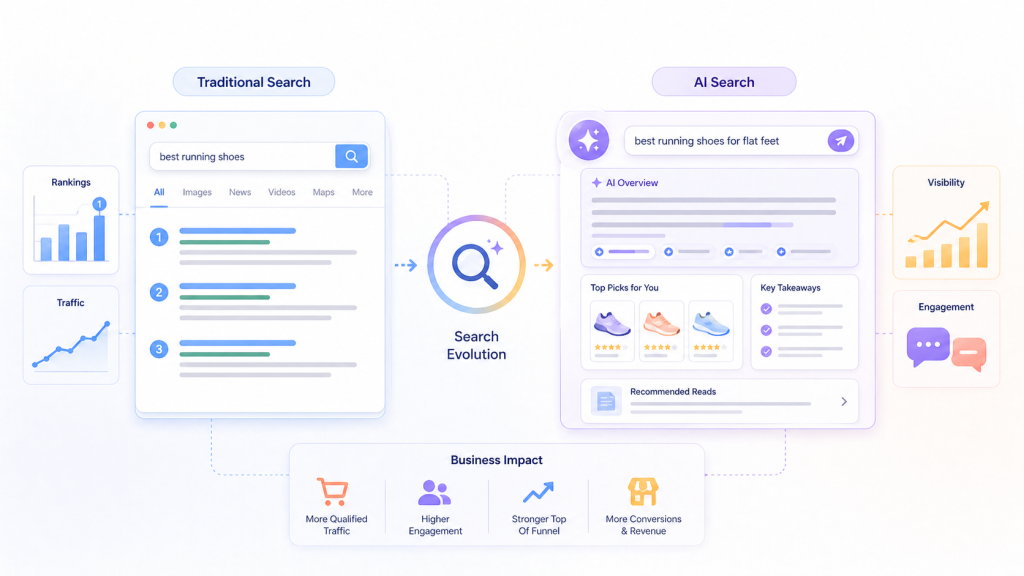
Big changes happening with Google search in 2026
Your customers are no longer just searching Google and clicking the first few blue links — they are asking AI-powered search tools for answers, comparisons, recommendations and buying advice.
That change is already reshaping SEO.
For years, Google SEO has been about helping websites rank for keywords. That still matters. But search is becoming more conversational, more personalised and more answer-focused. People are no longer only typing short phrases like “best running shoes” or “SEO agency Sydney.” They are asking detailed questions like:
“What are the best running shoes for flat feet?”
“Which Shopify SEO agency can help an ecommerce store grow without relying only on paid ads?”
“What is the best mattress topper for hot sleepers in Australia?”
“Which dog food brand is best for sensitive stomachs?”
“What should I look for before hiring a buyers agent?”
These searches are different because they show intent. The person is not just looking for a website. They want a useful answer.
That is why AI search is changing Google SEO.
Modern SEO is no longer only about ranking for a keyword. It is about becoming one of the trusted sources search engines and AI systems can understand, summarise and recommend.
For businesses, especially ecommerce and Shopify stores, this creates both a risk and an opportunity. If your website is thin, unclear or hard to understand, you may become less visible. But if your website clearly answers customer questions, explains your products properly and builds trust, AI search can help you appear in more discovery moments.
Understanding AI Search: How AI Delivers Direct Answers
AI search is search that uses artificial intelligence to understand questions and provide more direct answers.
Traditional search usually works like this:
- A person types a keyword into Google.
- Google shows a list of search results.
- The person clicks a website.
- They scan the page to find the answer.
AI search changes that experience.
With AI search, the person may receive:
- A summary answer
- A comparison
- A list of recommended products or services
- Key takeaways
- Follow-up questions
- Links to supporting sources
- A more conversational search experience
Instead of only showing websites, AI search tries to understand the question and help the user move closer to a decision.
This does not mean websites are no longer important. It means your website needs to be clear enough and useful enough to be included in those answers.
How Is Google SEO Changing?
Google SEO is changing from a keyword-first game into a usefulness, authority and context game.
That does not mean keywords are dead. Keywords still help search engines understand what a page is about. But keywords alone are not enough.
A page that repeats “best bamboo sheets Australia” twenty times is not automatically useful.
A better page would explain:
- What bamboo sheets are
- Why people choose them
- Who they are best suited for
- Whether they are good for hot sleepers
- How they compare with cotton sheets
- How to wash them
- What sizes are available
- What customers should check before buying
- Which products suit different needs
That kind of content gives search engines more context. It also gives customers more confidence.
The best SEO now answers the question behind the keyword.
Why AI Search Matters for Business Owners
AI search matters because customers are becoming more demanding.
They do not want to dig through ten websites to find one clear answer. They want help quickly.
That means your business needs to be visible where decisions are being shaped.
A customer might not search your brand name first. They may start with a problem, a comparison or a recommendation request.
For example:
“Best organic skincare for sensitive skin”
“Best bamboo bedding brand in Australia”
“Is a mattress topper worth it for back pain?”
“Shopify SEO agency for ecommerce growth”
“Best Australian dog food for puppies”
If AI search tools are summarising information from across the web, your business needs to send strong signals that explain what you sell, who you help and why you are worth considering.
This is especially important for ecommerce stores.
Many Shopify stores have decent products but weak content. Their product pages are short. Their collection pages have little explanation. Their blog content is random. Their FAQs are missing. Their reviews are not used properly. Their images are not well optimised.
In the old search world, that was already a problem.
In the AI search world, it becomes a bigger problem.
Traditional SEO vs AI Search SEO
Traditional SEO and AI search SEO are connected, but the focus is shifting.
Traditional SEO often focuses on:
- Ranking for target keywords
- Creating optimised pages
- Building backlinks
- Improving metadata
- Fixing technical issues
- Increasing organic traffic
AI search SEO still needs those things, but it also focuses on:
- Answering full customer questions
- Building topical authority
- Making content easier to summarise
- Providing clear product and service information
- Improving trust signals
- Structuring information clearly
- Supporting AI-generated answers with reliable content
The old question was:
“How do we rank for this keyword?”
The better question now is:
“How do we become the clearest and most trusted answer for this customer’s problem?”
That is a much stronger way to think about SEO.
What AI Search Means for Ecommerce and Shopify Stores
For ecommerce businesses, AI search can affect how people discover products.
Instead of searching only for a product name, customers may ask AI-style questions such as:
“What is the best bamboo quilt cover for summer?”
“What is the best mattress topper for side sleepers?”
“What is the difference between collagen powder and collagen capsules?”
“Which slow-cooked dog food is best for small dogs?”
“What should I buy for a newborn baby gift?”
These questions are closer to the buying journey. They show that the customer is considering options.
If your Shopify store has useful content that answers those questions, you have a better chance of being discovered.
But if your website only has basic product listings, you are making it harder for search engines and AI tools to understand your value.
A strong ecommerce AI SEO strategy should improve:
- Product pages
- Collection pages
- Buying guides
- Comparison articles
- FAQs
- Reviews
- Internal links
- Image optimisation
- Schema markup
- Technical SEO
- Brand trust signals
This is where many ecommerce stores can gain an advantage. Most competitors are still doing the basics poorly.
How AI Search Changes Keyword Research
Keyword research used to focus heavily on short phrases with search volume.
For example:
“bamboo sheets”
“dog food Australia”
“mattress topper”
“Shopify SEO”
“organic skincare”
Those keywords still matter, but they do not tell the full story.
AI search makes question-based and intent-based research more important.
You need to understand what people ask before they buy.
Examples include:
- What is the best option for my situation?
- How does this product compare with another product?
- Is this product worth the money?
- What are the pros and cons?
- What should I avoid?
- How do I choose the right size, type or material?
- What do reviews say?
- Is this safe, natural, durable or suitable?
For ecommerce stores, this is gold.
A product page may target the main keyword, but supporting blogs and FAQs can target the questions around that keyword.
That gives search engines a richer understanding of your store.
How AI Search Changes Content Strategy
AI search rewards content that is useful, clear and well structured.
That means businesses need to stop publishing content just to “have a blog.”
A weak blog strategy looks like this:
- Random topics
- Generic AI-written posts
- No internal links
- No product connection
- No original insight
- No clear customer journey
- No FAQs
- No commercial purpose
A strong blog strategy looks like this:
- Topics based on real customer questions
- Clear explanations
- Helpful examples
- Practical tips
- Links to relevant products or services
- FAQs that answer buying objections
- Updated content
- Evidence, reviews or experience where relevant
- Content that supports revenue, not just traffic
For Shopify stores, blog content should support the products and collections you want to grow.
For example, if you sell bamboo bedding, useful topics might include:
- Bamboo vs Cotton Sheets: Which Is Better?
- Are Bamboo Sheets Good for Hot Sleepers?
- How to Wash Bamboo Bedding Properly
- Best Bedding for Sensitive Skin
- What Is the Best Quilt Cover Material for Summer?
Each article should link naturally to relevant collection and product pages.
That is how content supports rankings, traffic and sales.
How AI Search Changes Product Pages
Product pages need to work harder now.
A product page with two sentences and a few images is not enough for competitive ecommerce SEO.
A strong product page should answer the questions customers have before buying.
Include information such as:
- What the product is
- Who it is best for
- Main benefits
- Materials or ingredients
- Size, fit or specifications
- How to use it
- How to care for it
- Delivery and returns information
- Reviews
- FAQs
- Related products
- Internal links to guides
This helps humans make a decision.
It also helps search engines and AI systems understand the product in more detail.
For example, instead of only saying:
“Premium bamboo quilt cover set. Soft and breathable.”
A stronger description would explain:
“This bamboo quilt cover set is designed for customers who want a softer, cooler and more breathable alternative to traditional cotton bedding. It may suit hot sleepers, people with sensitive skin, and those looking for a smooth, lightweight feel through warmer months.”
That gives far more context.
How AI Search Changes Collection Pages
Collection pages are one of the biggest missed opportunities in ecommerce SEO.
Many Shopify collection pages are just product grids. They may have a short heading and then a list of products.
That is not enough.
A good collection page should act like a mini buying guide.
It should explain:
- What the collection includes
- Who the products are for
- How to choose between options
- What features matter
- Common customer questions
- Related categories
- Links to helpful guides
For example, a “Bamboo Sheets” collection page could include sections such as:
- Why choose bamboo sheets?
- Are bamboo sheets good for hot sleepers?
- Bamboo sheets vs cotton sheets
- How to choose the right size
- How to care for bamboo sheets
- Frequently asked questions
This makes the page much more useful and gives search engines more confidence in what the page is about.
How AI Search Changes FAQs
FAQs are becoming more valuable because they match how people search.
People ask AI tools direct questions. Your website should answer those questions directly.
Good FAQs can be added to:
- Product pages
- Collection pages
- Service pages
- Blog articles
- Location pages
- Comparison pages
But the answers need to be useful.
Bad FAQ:
Are bamboo sheets good?
Yes, bamboo sheets are good.
Better FAQ:
Are bamboo sheets good for hot sleepers?
Bamboo sheets can be a good option for hot sleepers because they are usually lightweight, breathable and moisture-wicking. The best choice will depend on the fabric quality, weave and personal comfort preference.
That answer is more helpful and more likely to support AI search visibility.
How AI Search Changes Technical SEO
AI search still depends on technical foundations.
If your website is slow, messy or difficult to crawl, your content may not perform properly.
Technical SEO includes:
- Indexing
- Crawlability
- Site speed
- Mobile usability
- Broken links
- Duplicate content
- URL structure
- Schema markup
- Image optimisation
- Internal linking
- Canonical tags
- Sitemap health
For Shopify stores, technical SEO is particularly important because themes, apps, filters, variants and duplicate URLs can create issues.
AI search may feel new, but technical SEO is still the engine room.
You cannot build strong visibility on a broken foundation.
Practical Tips to Prepare for AI Search
Here is a simple action plan business owners can follow.
1. Improve Your Most Important Pages First
Do not start by creating 100 new blogs.
Start with the pages that matter most:
- Main service pages
- Top collection pages
- Best-selling product pages
- High-margin product pages
- Pages that already get impressions in Google Search Console
Improve the content, structure, FAQs, internal links and calls to action.
2. Add Better FAQs
List the questions customers ask before buying.
Then add clear answers to relevant pages.
Focus on questions about:
- Suitability
- Comparisons
- Pricing
- Delivery
- Returns
- Materials
- Use cases
- Results
- Timeframes
- Trust
3. Build Buying Guides
Buying guides are powerful because they answer decision-based searches.
Examples:
- How to Choose the Right Mattress Topper
- Best Bedding for Hot Sleepers
- How to Choose the Right Dog Food
- What to Look for in a Shopify SEO Agency
- Bamboo vs Cotton Sheets
These articles help customers and give search engines stronger context.
4. Use Clear Headings
AI tools and search engines need structure.
Use headings that clearly explain what each section covers.
Instead of vague headings like:
“More Information”
Use helpful headings like:
“How to Choose the Right Size”
“Who This Product Is Best For”
“Common Questions Before Buying”
“How This Compares With Other Options”
Clear headings make content easier to read and easier to understand.
5. Strengthen Trust Signals
Trust matters more than ever.
Add or improve:
- Reviews
- Testimonials
- Case studies
- About pages
- Contact information
- Shipping and return policies
- Product guarantees
- Author information
- Business credentials
- Real examples
AI search needs confidence. Trust signals help build it.
6. Use Google Search Console
Google Search Console shows what people are already searching before they find your website.
Look for:
- Questions
- High-impression keywords
- Pages with low click-through rates
- Products or collections that are close to ranking
- Search terms with commercial intent
This data can guide your AI SEO strategy.
Do not guess. Use data.
Common Mistakes Businesses Make With AI Search
Mistake 1: Thinking SEO Is Dead
SEO is not dead. It is changing.
Businesses still need to be visible when people search. The methods are evolving, but the goal is the same: be found, be trusted and be chosen.
Mistake 2: Publishing Low-Quality AI Content
AI can help create content, but it should not replace strategy.
Generic AI content with no experience, no proof and no useful examples will not build a strong brand.
Mistake 3: Ignoring Ecommerce Money Pages
Blogs matter, but product and collection pages are where revenue happens.
Improve those pages first.
Mistake 4: Writing for Keywords Instead of Customers
Keywords are useful, but customers ask questions.
Answer the real questions behind the keyword.
Mistake 5: Not Tracking Results
SEO should be measured.
Track:
- Rankings
- Organic clicks
- Impressions
- Traffic quality
- Assisted conversions
- Organic revenue
- Product and collection page performance
For ecommerce businesses, revenue matters more than traffic alone.
How Search Results Helps Businesses Adapt to AI Search
Search Results helps businesses improve visibility across Google and AI search environments, with a strong focus on ecommerce and Shopify stores.
Our approach is practical.
We look at the website as a whole, including:
- Technical SEO
- Product page optimisation
- Collection page optimisation
- Blog content strategy
- FAQ development
- Google Search Console data
- Internal linking
- Ecommerce revenue opportunities
- AI search visibility
- Ongoing improvement
The goal is not just to get more traffic. The goal is to attract better traffic and help turn that visibility into enquiries, sales and revenue.
For established Shopify and ecommerce businesses, AI search creates a real opportunity. Many competitors still have thin content, weak product pages and poor structure. Fixing those issues can make your store easier for both Google and AI tools to understand.
FAQs About AI Search and Google SEO
How is AI search changing SEO?
AI search is making SEO more focused on clear answers, helpful content, trust signals and context. Keywords still matter, but businesses also need to answer detailed customer questions and show why they are credible.
Does Google SEO still matter?
Yes. Google SEO still matters. AI search does not remove the need for strong SEO. It makes clear, useful and trustworthy website content even more important.
Will AI search reduce website traffic?
It may change how traffic behaves. Some simple questions may be answered directly in search results, but businesses with strong content can still benefit by being included as trusted sources, recommendations and supporting links.
Can ecommerce stores appear in AI search results?
Yes. Ecommerce stores can improve their chances by creating strong product pages, helpful collection pages, buying guides, comparison content, FAQs, reviews and technically clean websites.
What content works best for AI search?
Content that clearly answers customer questions, explains products or services in detail, compares options, provides practical advice and demonstrates trust is more likely to support AI search visibility.
Should I use AI to write SEO content?
AI can help with research, outlines and drafts, but the final content should be reviewed and improved by people who understand your business, customers and products.
How can Shopify stores prepare for AI search?
Shopify stores should improve collection pages, product descriptions, FAQs, internal links, image optimisation, reviews, schema and technical SEO. They should also create helpful buying guides around real customer questions.
Final Thoughts
AI search is changing Google SEO, but it is not removing the need for SEO.
The businesses that win will be the ones that are easiest to understand, easiest to trust and most useful to customers.
For ecommerce and Shopify stores, this is a major opportunity. Search is becoming more conversational and more recommendation-based. Customers are asking better questions, and search engines are looking for better answers.
If your website gives those answers clearly, you improve your chances of being found.
If your website is thin, vague or poorly structured, you risk being left out.
Search Results helps established ecommerce businesses improve visibility across Google and AI search with practical SEO strategies focused on rankings, traffic and revenue.